

‘HSE University–St Petersburg Teaches You to Think Globally’: Student from India Immerses Herself in Russian Media Landscape
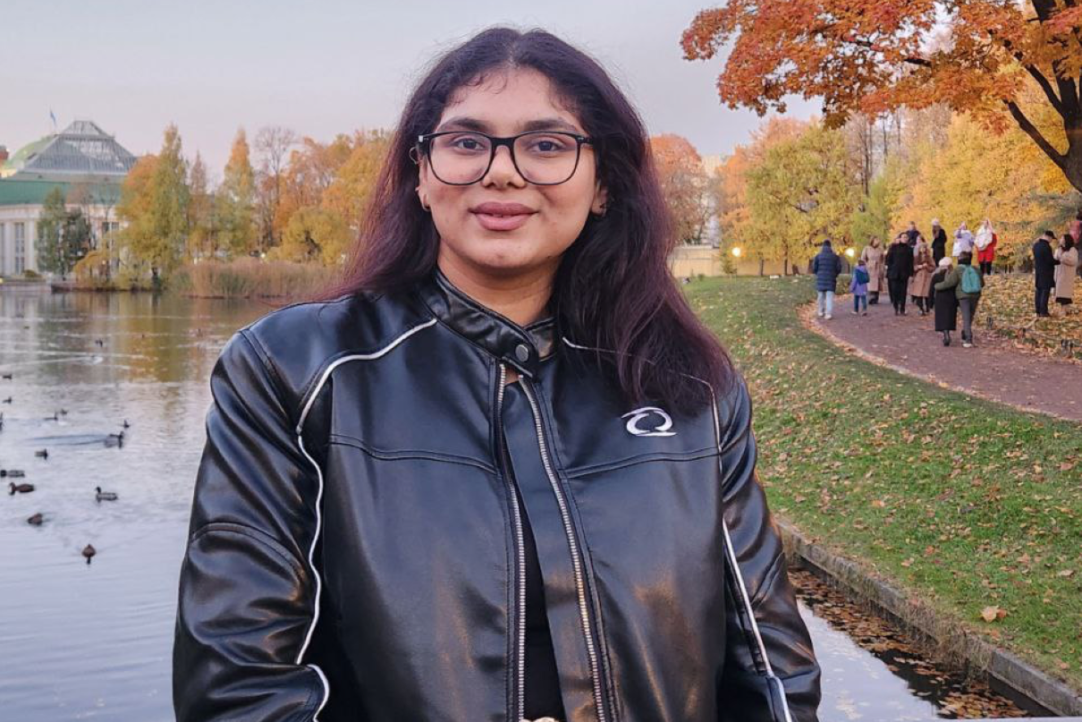
Prithvi Abhay Shankaregowda came from India under the academic mobility programme. She studies journalism and mass communication and has already got to know St Petersburg. Read on to find out her impressions of Russians, the importance of a global perspective at various events, and projects at HSE University–St Petersburg.
— Why did you choose Russia for your mobility programme?
— This is not my first student exchange. Before this, I studied in Malaysia for one semester. After experiencing Southeast Asian culture and that kind of exposure, I wanted to explore something in the north. As Russia is located both in Europe and Asia, I was curious about its culture. Apart from studies, I'm getting to know the Russian people, weather, and traditions. Russia provides me with a unique experience: the media landscape here is very different from those in India and Malaysia. That is why my main goal is to explore everything.

— What are your first impressions of studying here? What do you like the most about HSE University?
— In India, there are less studies at the university and more practice outside of it. For example, after a lecture, we get an assignment for which we have to talk to people, interview them, and do projects. In Russia, there are more classroom activities, research work, and seminars with discussions and presentations. We get to know people from different countries, communities, and cultures. That is very interesting, and it broadens my horizons in terms of theoretical understandings of situations.
— What is the study process like? Was it difficult for you to adapt?
— I'm still settling in. There were some issues with my registration and some administrative stuff. But I am very happy that the team of the International Student Mobility Office support me and help with any issues. That is why the adaptation was smooth for me.
I really like the professors here. My classmates are really engaged in the studies and welcoming to international students. Helping organise the celebration of Diwali at HSE University–St Petersburg at the end of October was a great experience. I have always helped with various events at my university in India. I was curious about how such events are organised in Russia. The festival went well: it is very important to give Indians an opportunity to share their culture in a different country.
— Have you taken part in any other extracurricular activities at HSE University–St Petersburg?
— Yes, I attended two events during the first days after my arrival—bus and walking tours. I was new in the city, and I didn't know what I could see here. The tours were really informative; we learned a lot about the architecture, history, and interesting places in St Petersburg.
I also went to a party organised by the Taylor Swift Club. I also know that there are ballroom dance lessons every week. I haven't attended yet but I'm really into this, so I think I will sign up. I am also keen on music but all the HSE music clubs are held in Russian. It would be great if they could integrate international students into their activities.


— Last year, you were an exchange student in Malaysia. HSE University–St Petersburg also has agreements with Malaysian universities. Have you noticed any interesting differences between the three countries in which you've studied?
— Yes, the experience of studying in Malaysia is greatly different from those in India and Russia. The curriculum was very flexible and the assignments were completely different in terms of their interconnection to culture. For instance, I had an assignment in my advertising course where I had to make a 30-second advertisement for the KLIA Express, a train that runs from the airport to Kuala Lumpur, the capital city. We had to make an advertisement to be played in metro stations and other public places like that. I teamed up with some Indonesian exchange students. In the end, our advertisement got selected and was running in the metro!
Although all three of the learning experiences really differ from each other, they have contributed a lot to my studies for sure.
— What is your general impression of St Petersburg? How is daily life in Russia different from that in India?
— I really like the city and the people. Everyone is very welcoming. If I ask somebody for help, I will get it even if that person doesn’t speak English.
When I landed in St Petersburg and was waiting for my taxi, I met the two nicest people ever. They also were going from the airport to the city. I'll never see them again, I don't have their contacts, and I don't remember their names, but just talking with them for five minutes made my day. They asked me whether I had arrived in Russia for the first time, hoped that I have fun here, and recommended some interesting places. It was my first experience of talking to Russians. Later, I found out that it's the same everywhere: even in my dormitory, everybody is so welcoming. I have made a lot of Russian friends who make me feel at home in a foreign country, which is very important for international students.


— You have various media skills—for example, editing. Moreover, you even have a blog. What has shaped your interest in media?
— In high school I was a science student: I studied physics, chemistry, and biology because I planned to go into the medical field. But then, after graduation, I started reflecting on what kind of career I actually wanted, what interests I had, and what I wanted my life to look like in five or ten years.
This is how I realised that I was more interested in politics, social sciences, advertising, and marketing. That’s why I decided to switch to media and enrolled in a university that is famous for education in journalism and mass communication.
I am keen on media, communications, and PR. Moreover, I'm a podcast person—I love listening to them and I even have a few podcasts of my own. That is what motivated me to learn video and sound editing.
— What are your plans for the future? Would you like to go to other countries?
— For me as a student of journalism and mass communication, it's very important to explore various countries, cultures, and media landscapes. I like to think that I'm not just a citizen of India, but a citizen of the world. Of course, your nationality, culture, and heritage are very important factors, but to make the right decisions, you have to look at them from a global perspective. When reporting news or participating in a global event, you have to think about them from the perspective of all kinds of people from various countries and of different nationalities. Having a global perspective in journalism is vital, so that’s why I hope to visit a lot of countries. I suppose my main interest is going to be travelling around the world in order to find stories that I can tell about different cultures and people.
Interviewed by Ekaterina Evzelman, 2nd-year student of the Bachelor’s programme ‘Political Science and World Politics’