
From Borscht to Syrniki: My Russian Food Starter Pack
When I first moved to Russia, I didn’t worry about snow as much as I worried about food. Not because I’m picky—but because food is comfort, and comfort is the first thing you miss when you live far from home. I’m Vietnamese, from Hanoi, a city where you can step outside and let street food solve your entire day. In Hanoi, meals are loud and quick and full of fragrance: grilled smoke, fish sauce, herbs, chili, hot broth, tiny plastic stools, the sound of a motorbike passing way too close to your elbow. Our food doesn’t just feed you; it talks to you. It’s immediate. Friendly. Familiar.
Russian food, on the other hand, felt… distant at first. Like the people, honestly. Russians are not rude—just not instantly warm in the way Vietnamese culture often is. You don’t always get smiles from strangers. You don’t always get small talk. The warmth is there, but it’s deeper, slower, earned. Russian food is similar. It doesn’t always try to seduce you with aroma from ten meters away. It doesn’t always hit you with bright sweet-sour-salty in one bite. The flavors can seem muted. The textures can surprise you. Some dishes look “simple” but taste heavy. Some look strange and taste even stranger. And yet—if you stay long enough, if you eat with people rather than just in places, Russian food becomes one of the most comforting parts of living here. This is my Russian food starter pack: the dishes I didn’t expect to love, the ones I learned through HSE canteens, friends’ kitchens, and that uniquely Russian concept that changed my relationship with lunch forever — the “complex.”
The first lesson: Russian food is not always restaurant food
A lot of international students try Russian cuisine the same way tourists do: fancy restaurants, Instagram plates, “traditional” menus translated into English, maybe a Georgian place by accident, maybe sushi because it’s safe. And yes—Russian food in a high-end restaurant can be good. Russian food in industrial-style cafes can be okay too. It fills you up. It does the job.
But here’s what I learned: Russian cuisine isn’t at its best when it’s trying to perform.
Vietnamese food shines on the street. You don’t need a white tablecloth to make phở legendary. In fact, the more “normal” the place looks, the better it often is. Hanoi’s street food is chaotic, fast, and deeply personal. The best bowl might come from a tiny shop with one auntie who has been doing the same broth for twenty years.
Russian food doesn’t work exactly like that. There are street snacks here, sure, but the true heart of Russian food—its real warmth—often lives at home, inside family kitchens, inside conversations, inside the idea that food is meant to keep you alive through winter and through life.
At a Russian family table, soup is hotter. The котлета (kotleta) is thicker and juicier. The salad is not a small “side,” it’s a serious commitment. The tea keeps coming. The bread never ends. Someone is always telling you to eat more like your life depends on it.
That’s when Russian food starts to feel friendly.
My daily gateway drug: HSE canteen and the “complex lunch”
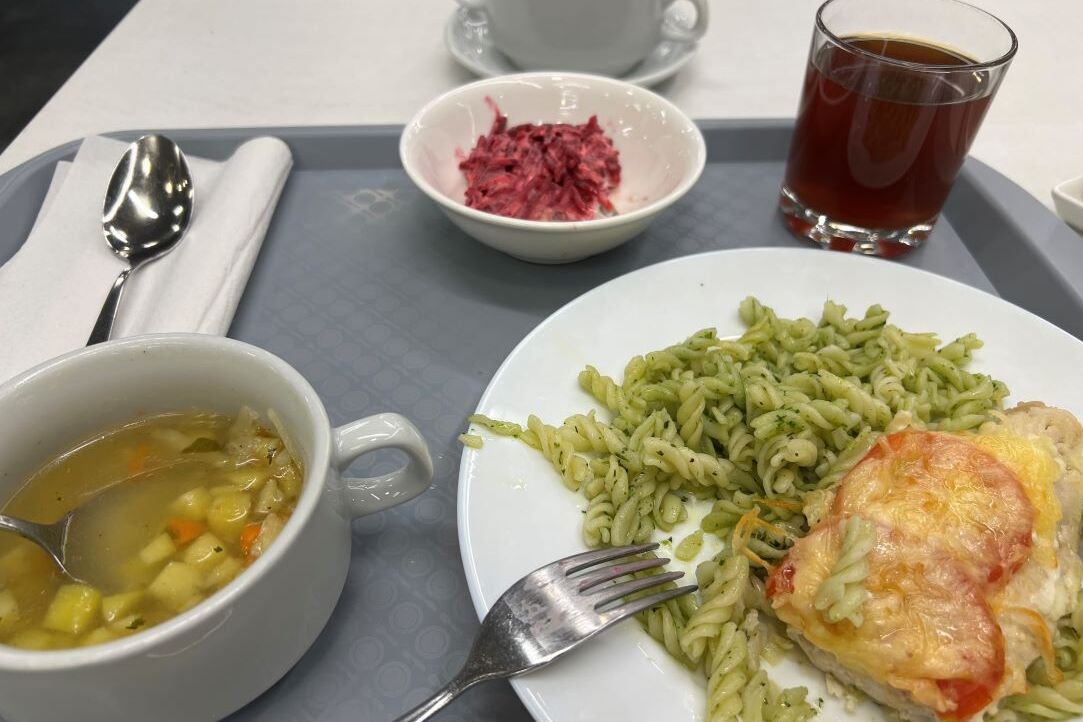
At HSE, especially in the canteen, there is one system that quietly teaches you how Russians eat: Комплексный обед — the complex lunch.
It’s basically a set meal, usually built like this:
- Soup (a bowl that makes you feel like you can survive anything)
- Main dish (meat or fish + garnish like buckwheat, pasta, potatoes, rice)
- Salad (often mayonnaise-based, often surprisingly filling)
- Drink — very often kompot (a sweet fruit drink that feels like childhood)
For Vietnamese students, this setup is almost funny at first. In Vietnam, a “set meal” exists too, but in daily life we often eat one big dish: noodle soup, rice plate, bún chả, phở, cơm rang—fast and focused. Russian lunch feels like a structured ritual. It says: sit down. Warm up. Take your time. Eat in stages. Drink something sweet. Go back to work.
The first few times I tried the complex, I felt confused. Why so many parts? Why is salad cold? Why do people drink something sweet with savory food? Why is soup at lunchtime non-negotiable?
Then one day, after walking outside in freezing air, sitting in a warm canteen with a hot bowl of soup felt like someone turned my nervous system from “alert” to “safe.”
And suddenly, I understood: the complex lunch isn’t just food—it’s a survival design for winter, for work, for long days.
It taught me the Russian logic of comfort.
Borscht: the dish I expected to respect, but didn’t expect to love
Let’s start with the king of my starter pack:
Borscht
Before Russia, I knew borscht as “that red beet soup.” I expected it to taste earthy and weird, like a health drink pretending to be dinner. But real borscht—especially homemade—hits differently.
A good borscht is rich, slightly sweet, slightly sour, and deeply warming. It’s not aggressive in flavor, but it has depth. The cabbage, the beet, the broth, sometimes beef—everything comes together like a slow conversation. And then there’s the iconic move: smetana (sour cream) on top.
The first time I added smetana, my brain protested. In Vietnam, we don’t put sour cream in soup. That sounded illegal.
But once it melted into the hot broth? It softened the edges, made the soup feel rounder, calmer, more complete. Like winter made edible.
Borscht became my “reset” meal. When I’m tired, stressed, or homesick, borscht feels like a blanket. Not a flashy blanket—an old reliable one.
Russian salads: the surprising main characters
If you think salad is light, Russia will correct you.
Russian salads are not just vegetables. They are a philosophy: salad as a full meal, salad as celebration, salad as identity.
Olivier salad: the classic that grows on you
Olivier is everywhere: birthdays, New Year, family dinners, cafeterias. Potatoes, carrots, peas, eggs, pickles, meat (or sausage), mayonnaise—mixed into one creamy universe.
As a Vietnamese person, I needed time. We like freshness. Herbs. Crunch. Acid. Russian salads can feel heavy, especially with mayonnaise.
But the more I ate it, the more I respected it. Olivier is not about “fresh.” It’s about comfort and stability. It tastes like someone prepared it for you in advance because they care that you’ll be full.
Seledka pod shuboi: my personal obsession
This one deserves its full name because it’s iconic:
Селёдка под шубой — “herring under a fur coat.”
Layers of salted herring, potatoes, carrots, beet, onion, mayonnaise—like a cake, but savory and pink-purple.
I understand why some foreigners fear it. It looks intense. It tastes like the sea met a root vegetable garden and decided to become friends.
But for me? It’s incredible.
The saltiness of herring + sweetness of beet + creamy mayonnaise creates a flavor that shouldn’t work, but absolutely does. It’s complex, like the best kind of weird. The first bite is shocking; the third bite is addiction.
This dish taught me something important: in Russian cuisine, beauty is often layered, not immediate.
Syrniki: proof that Russian comfort can be sweet
If borscht warmed my winter, syrniki warmed my mornings. Syrniki are small fried творог (curd cheese) pancakes—soft inside, golden outside. Usually served with smetana, jam, honey, or condensed milk. I didn’t expect to love them because I thought they would taste too “cheesy.” But syrniki are gentle. They don’t scream sugar. They feel like breakfast made by someone who wants you to have a good day. This is one of the first Russian foods I recommend to Vietnamese friends because it’s friendly. It’s an easy entry point. It’s like: “Okay, Russia, I see your soft side.”
Kompot: the drink that feels like a childhood memory
Kompot is simple: fruit boiled with sugar, served warm or cold. Apples, berries, dried fruits—it depends.
At first I thought: why drink this with lunch? Then I realized: kompot is not just a drink; it’s a mood. It’s the sweet ending that tells your body the meal is finished. It also balances salty, heavy food.
In Vietnam, we often end meals with fruit, chè, or just tea. Kompot plays a similar emotional role: a small sweetness, not too serious, a little nostalgic.
Even in an HSE canteen, kompot makes lunch feel like someone’s grandma is quietly taking care of you.
Kotleta and buckwheat: the “Russian default setting”
If there is a Russian “default lunch plate,” it might be:
kotleta + гречка (buckwheat).
Kotleta is not exactly a Western cutlet—it’s more like a thick, pan-fried meat patty, sometimes mixed with bread, onions, spices. Buckwheat is earthy and nutty, and it shows up everywhere because it’s cheap, filling, and oddly satisfying.
Many Vietnamese students don’t love buckwheat immediately. The smell is strong. The taste is serious. It’s not fragrant like jasmine rice. But give it time. Buckwheat grows on you the way Moscow grows on you: slowly, then suddenly you can’t imagine daily life without it. It’s the taste of “I’m doing real life here.”
The dish many people hate: Kholodets (and its Vietnamese cousin)
Now, let’s talk about the most controversial one:
Kholodets — meat in jelly (aspic).
Fun fact: many Russians themselves don’t like kholodets. It’s not a universal love. It’s one of those “family tradition” foods that people either defend passionately or avoid completely.
When I first saw it, I thought it was a prank. Meat… inside transparent jelly? Cold? Why?
Then I remembered Vietnam has something similar:
thịt đông — Vietnamese jellied meat, usually eaten in the North, especially in colder weather.
Suddenly, I understood kholodets emotionally even if my mouth was still unsure. It’s the same winter logic: preserve, cool, make food that lasts, create something dense and nourishing.
Do I crave kholodets? Not really.
Do I respect it? Yes.
Do I laugh every time I see it because it looks like food from another dimension? Also yes.
But it’s a great conversation dish—especially when you tell Russians: “We have this in Vietnam too.” Their surprise is priceless.
What Russian food taught me about Russian people
Here’s the big thing I didn’t expect:
Russian food taught me how Russians love.
Not with brightness. Not with instant friendliness. Not with loud sweetness.
But with depth. With warmth that comes later. With care that looks practical: eat more, take soup, don’t go outside hungry.
Vietnamese hospitality is fast and expressive. Russian hospitality is steady and protective. Both are real, just different styles.
And once you eat in a Russian home—real soup, real котлета, salad that someone spent time layering, tea served again and again—you realize Russian cuisine isn’t meant to be “light and easy.”
It’s meant to make you feel safe.
My Russian food starter pack list
If you’re a new international student and you want to “unlock” Russian food step by step, here’s my starter pack:
- Syrniki (easy, sweet, friendly)
- Borscht (warm, iconic, comforting)
- Pelmeni (simple, reliable, great with sour cream)
- Kotleta + mashed potatoes / buckwheat (canteen classic)
- Olivier salad (the social default)
- Seledka pod shuboi (advanced level, worth it)
- Kompot (the meal-ending vibe)
- Kholodets (optional boss fight—try once for the story)
Closing: the complex lunch is more than a meal
The “complex” lunch at HSE started as a practical student option for me: cheap, fast, filling. But over time it became cultural education.
It taught me that Russian food isn’t trying to impress you in one bite. It’s trying to build something in you slowly: warmth, patience, resilience. It’s the cuisine of a country that knows winter, and knows that comfort has to last longer than a moment.
Now, when I sit in the canteen with my tray—soup, main dish, salad, kompot—I sometimes smile, because it feels like I’ve learned a small part of Russia’s language.
Not the grammar of Russian words. The grammar of Russian care.
And somewhere between borscht and syrniki, between the Neva humidity and Moscow speed, between Hanoi street food memories and a cafeteria “complex,” I found a new kind of comfort—unexpected, quiet, and real.
Tried and shared by

Фам Тхэ Ань
